Wednesday, November 11, 2015

Guest Post - Jay Wilburn #WinterofZombie 2015

Guest Post: Jay Wilburn #WinterofZombie

Dead Song Book 2 front cover
Winter of Zombie 2015
Familiar Characters – Same, But Different
by Jay Wilburn
I worry a little bit about creating my characters. It stresses me a little less in a short story. I can let them explode out on the page and usually build the dimensions I need in a short space. In longer works, I stress a little more. I typically end up with a bigger cast. I want them all to want something. Even if some of them are working toward similar goals, I want them to be different and speak differently – act differently. I want them to be realistic, but sometimes what makes characters real is difficult to sell on the page.
I wrote a post on social media earlier about my struggle to write realistic, flawed characters. Flawed characters are interesting characters. This is because all people are broken in small and big ways to varying degrees. We recognize this on some under layer of our minds where we occasionally find the capacity for empathy. This is why well written flaws make the best, most interesting characters in writing.
There are two important flaws that all people have, but we hate in others on such a deep level that they are difficult to write well because people want to hate them and reject them in characters on the page too. All people are hypocrites, but we despise the revelation of hypocrisy in those around us. None of us live up to our own ideals. All of us have beliefs that we aspire to and fall very short of. We hide this in ourselves and that is the formula for hypocrisy that we all carry in our emotional chemistry.
The other universal flaw is even more difficult for me to write well. We all seek to point out the good to be found within us while at the same time tuning our senses and minds to identify the bad in others and the world around us. Sometimes we do it to try to improve our own good through a grading curve, sometimes we do it because we think we can battle that bad and win, and sometimes we don’t even realize we are doing it. A realistic character would possess both these flaws, but it is a real work of art to write a judgmental hypocrite that people will like.
A friend of mine brought up the point of depression being a factor that negates people finding the good in themselves. I would argue that while we still all probably hate things about ourselves, we’ll still gloss those things over in a moment of expressing our relative virtues or in comparing ourselves to greater evils in the world. I explained it in that discussion like this. Depression isn’t experienced the same by all people. Lots of people, depressed or otherwise, can still hate themselves and hate things about themselves and their lives. At the same time, they’ll still have the “us and them” categories. A depressed Democrat will still see their beliefs as good and Republican beliefs as evil or vice versa –same thing with religious and non religious.
Feeling bad about one’s self does not exempt someone from this inward versus outward tendency. On the page in particular, self hatred is probably best portrayed as a great disappointment the character feels for not having achieved what he or she feels is deserved from individual destiny. The manifestation of that then is seeking to right that perceived wrong through playing out those two universal flaws mentioned above.
If done well, these characters would appear wildly unique on the page, but in reality they would be intimately familiar because they would be exactly like all of us. Maybe this is a bit much to try to achieve in a zombie story, but I don’t think so. The humans really should have a few more dimensions than the zombies do, I think. The unique aspect would be in selling these characters with the flaws that we are not willing to see within ourselves. If I figure out how to do this, I’ll be sure to let you know.

Dead Song Legend Dodecology Book 1: January from Milwaukee to Muscle Shoals
Start the series here è http://amzn.to/1CvxbST
Dead Song Legend Dodecology Book 2: February from Vicksburg to Cherokee
Continue the series here è http://jaywilburn.com/book-2/
Check out the first soundtrack to the series, The Sound May Suffer: Music from the Dead Song  here è http://www.cdbaby.com/cd/thesoundmaysuffer6
or on Spotify. The hard CD is also available on Amazon.

Author Jay Wilburn
Jay Wilburn lives with his wife and two sons in Conway, South Carolina near the Atlantic coast of the southern United States. He has a Masters Degree in education and he taught public school for sixteen years before becoming a full time writer. He is the author of many short stories including work in Best Horror of the Year volume 5, Zombies More Recent Dead, Shadows Over Mainstreet, and Truth or Dare. He is the author of the Dead Song Legend Dodecology and the music of the five song soundtrack recorded as if by the characters within the world of the novel The Sound May Suffer. He also wrote the novels Loose Ends and Time Eaters. He is one of the four authors behind the Hellmouth trilogy. Jay Wilburn is a regular columnist with Dark Moon Digest. Follow his many dark thoughts on Twitter, Instagram, and Periscope as @AmongTheZombies, his Facebook author page, and atJayWilburn.com
*   *   *   *   *
The stench of frozen flesh is in the air! Welcome to the Winter of Zombie Blog Tour 2015, with 40+ of the best zombie authors spreading the disease in the month of November.
Stop by the event page on Facebook so you don’t miss an interview, guest post or teaser…and pick up some great swag as well!
Giveaways galore from most of the authors as well as interaction with them!
#WinterofZombie is the hashtag for Twitter, too!

Guest Post - Scott M. Baker #WinterofZombie 2015

Guest Post: Scott M. Baker #WinterofZombie

a photo of me at Wewelsburg
Is the zombie craze about to come to an end? 
It’s a legitimate question. The genre has been spreading like a zombie outbreak ever since Brian Keene released The Rising back in 2003 and breathed new life into a dead market, culminating in The Walking Dead. With the development of their hit series, AMC has succeeded in doing what no other television show, movie, or novel had accomplished before—making zombies mainstream. The series is one of the most watched programs on television, and the convention circuit and merchandising for The Walking Dead is an industry onto itself. Yet it’s the very popularity of a genre that often leads to its decline because success breeds imitation. While imitation is often the sincerest form of flattery, it’s also the best way to make a quick buck, which has led to a seemingly endless influx of zombie novels, movies, TV, shows, and video games.
Fans have been treated to some truly outstanding books (Patient Zero and World War Z), films (The Horde, Zombieland, and The Dead), and video games (Resident Evil, Dead Island, and Left 4 Dead). Unfortunately, we have also seen zombies placed in every scenario imaginable, facing off against strippers, cheerleaders, ninjas, cockneys, and even Abraham Lincoln. Enough zombie romances and comedies have entered the market to spawn the creation of their own subgenres, zomroms and zomcoms. The living dead have even made their way into TV commercials. Traditionally, once a horror icon becomes the subject of farce, its demise is inevitable. (A good case in point is Universal Studio’s cache of monsters from the 1930s and 1940s, all of whom lumbered through countless resurrections until permanently put to death by Abbott and Costello).
So does this overabundance of zombies in our culture mean the craze has burnt itself out and is about to subside?

Far from it. Zombies are different because they fill a niche no other monster is capable of.

Vampires, werewolves, and other ghoulish creatures and creepy crawlies will always thrill us. Vampires appeal to that dark erotic nature of our personalities that we keep bridled, while werewolves remind us of how violent and uncontrollable our subconscious truly is. The other monsters are adult manifestations of those things in the closet that scared us as kids. They are fantasy, and we don’t care. We sit in a darkened movie theater, or become engrossed in the pages of a novel until the late hours of the night, and relish what horrors await. We know that as long as the characters can survive to the end, then they will continue to live normal lives.
Zombies strike a chord with us because they tap into our deepest emotional and psychological fears.
First, there is an undertone of realism to the zombie genre that is terrifying. Despite exaggerated reports of Ebola victims rising from the dead or the ingestion of bath salts turning drug addicts into flesh-eating ghouls, no one honestly expects a zombie apocalypse. What is frightening about the scenario, however, is that it represents a total collapse of society as we know it and the breakdown of everything we hold dear. We didn’t create our own Hell by messing around with a Ouija board or a black and gold puzzle box. Factors beyond our control initiated the outbreak, and now we are forced to defend ourselves and our families as the living dead hunt us down in our own neighborhoods.
This scenario has been brought home to us repeatedly over the past decade by around-the-clock news, which has piped microcosms of the apocalypse into our homes. We sat glued to our television sets while watching the flood waters of Katrina inundate New Orleans and tsunamis devastate the coast of Japan. It took days, and in some cases weeks, before local and federal governments could enter the devastated areas and reestablish control. In the case of New Orleans, the devastation was accompanied by the collapse of the social order. Looters took advantage of the chaos. People had to fend for themselves in order to survive, sometimes against the local authorities. Our hearts went out to the victims of these natural disasters while a part of us breathed a sigh of relief that there but for the Grace of God goes us. The fear that zombies generate is that, if an outbreak ever did occur, we would suddenly become those nameless victims and would be forced to confront bitter realities about how we would react in such a situation.
Second, as strange as it sounds, a zombie apocalypse provides a grim hope for the future in the form of a “reset” button. All the seemingly insurmountable troubles we face disappear, and the playing field is leveled overnight. We’re no longer a part of the 1% or the 99%, a liberal or a conservative, a payer of taxes or a recipient of a government subsidy, a member of the elitist upper class or the struggling working class. All of our debts, our past mistakes, and our concerns would be wiped out overnight. Our possessions and social status would become irrelevant. All that would matter would be our strengths and abilities, and the direction in which our moral compass points.
One of my favorite zombie movies is Zack Snyder’s 2004 reimaging of Dawn of the Deadbecause of its portrayal of how ordinary people would react during a total collapse of the social order. Would we become Anna or Michael, who try to maintain their humanity even after losing everything dear to them? Would we become Kenneth, who opts to look out only for himself? Would we become CJ, the mall security guard who turns away the survivors because “no one here is infected and I intend to keep it that way?” Or would we be Tucker or Frank, the nameless faces that blend into the background and merely go on existing, only to become the red shirts of the survivors? Confronting how we would behave in such a situation can be scarier than dealing with the zombies.
The struggle between surviving and maintaining some semblance of humanity is what the genre is all about (combined, of course, with some intense gut-munching, head shooting action and buckets of blood and gore.) We will be entertained by an occasional zomcom, or a zombie falling in love with a teenage girl or being a boy’s loyal pet. We might even have to endure zombies that glitter in the sunlight. However, as long as fans are terrified by the end of the world, then zombies will always provide them with a frightening and exciting why to exploit that angst.
*   *   *   *   *
The stench of frozen flesh is in the air! Welcome to the Winter of Zombie Blog Tour 2015, with 40+ of the best zombie authors spreading the disease in the month of November.
Stop by the event page on Facebook so you don’t miss an interview, guest post or teaser…and pick up some great swag as well!
Giveaways galore from most of the authors as well as interaction with them!
#WinterofZombie is the hashtag for Twitter, too!

Tuesday, November 10, 2015

Guest Post - Greg P Ferrell #WinterofZombie 2015

Guest Post: Greg P Ferrell #WinterofZombie

2015-05-09 15.04.05_resized
In honor of being a part of this year’s Winter of Zombie blog tour, here is a set of short stories written exclusively for the visitors to the tour. These were started back during the Summer of Zombie tour. They’re from the perspective of one, Tony the Zombie, and his personal gripes against us humans. Typed out by Greg P. Ferrell because really, have you ever seen a zombie use a keyboard? It’s not pretty.


A day in my dead life!
Chapter 4
By: Tony the zombie
Translated by: Greg P. Ferrell
Well this seems to be more relevant than I thought it would be after my last post. So let’s talk about traps.

I have just recently crawled out of a large hole in the ground that was lightly covered with sticks and leaves. I also have two large pointy sticks stuck in my legs and they are really hindering my normally graceful lumbering stride. Really people, do you have to keep setting up so many of these traps everywhere? I’m not just talking about the large holes even though they are some of the more annoying of the traps. Just the other day I was meandering about with a few of my fellow undead, I was asking them something really important and when I didn’t get an answer back, I turned to find that I had been talking to myself for quite sometime since they had fallen into one of those big holes a ways back. I had to look like the biggest idiot just lumbering along talking to myself.

But there are other traps that you like to set up that are really annoying too. Those spring loaded ones that come swinging from out of nowhere with a sharp blade or ax attached to them are not cool at all. I watched the kind hearted man that brought me into this existence catch one of those in the head, and he went down faster than a zombie on top of a slow fat kid. Then there are the fire traps that really, pardon the pun, burn my ass up. Come on, fire doesn’t kill us, it just makes us well done. Plus I know the smell has got to bother you because it really disgusts us. I smell one of my brothers on fire, and I will immediately turn and go the other way.

Those are just the common ones but I’m really talking about any traps you use. You spend all that time making a trap, and you get maybe one or two of us when you could’ve spent that time doing something useful like eating something and fattening yourself up a little. Regardless of your thoughts on them, just stop doing it. They slow us down but never stop us. So that’s my thoughts on that for today. Now please excuse me while I go look inside this large hole on the ground and see what it is. Till next time remember Zombies are not your enemy, we’re… oh wait yeah we are.
*   *   *   *   *
The stench of frozen flesh is in the air! Welcome to the Winter of Zombie Blog Tour 2015, with 40+ of the best zombie authors spreading the disease in the month of November.
Stop by the event page on Facebook so you don’t miss an interview, guest post or teaser…and pick up some great swag as well!
Giveaways galore from most of the authors as well as interaction with them!
#WinterofZombie is the hashtag for Twitter, too!

Guest Post - Russell R James #WinterofZombie 2015

Guest Post: Russell R James #WinterofZombie

QIsland72lg

The Staying Power of the Undead


You can’t keep a good zombie down. At least not without a bullet to the head, and certainly not since 1968. Why does this fictional terror maintain its hold on our psyche across generations? Because zombies are relentless? Remorseless? Repellent? Nope.
Because they were once us. Sure, aliens and demons are scary. I’m not in a hurry to meet any of those. But there’s a separation between them and humanity, a line they cannot cross that places a subconscious, psychological distance between us and them. Zombies, however, were once human, and in the same horrific way that a serial killer was once a cute little Cub Scout next door. There’s a relatable reference point to see just how awful this creature has become.
But that brings on the ultimate zombie-inspired spine-tingle. You could become a zombie. The terror that physically hunts you while you are awake continues to psychologically, subconsciously hunt you as you sleep. Turning zombie separates us from our humanity, the only thing that places us above the beasts. The infection melds the horror of a diagnosis of ALS with the curse of having it never be fatal. Imagine an eternity spent existing as an undead monster, with no escape except through your execution by some other terrified human being, who you’d just as soon kill before he did you the favor. There’s no silver lining to this black cloud.
It is the sum of many fears we all harbor: aging, Alzheimer’s, cancer, the list goes on. All these afflictions eventually turn us into someone we never were before, and someone we definitely don’t want to be. And as with all of them, there is no return, no cure. How better to try and subjugate that fear than by dealing with it fictionally before we have to deal with it factually.
We are about a decade into America’s latest danse macabre with the zombie phenomenon. Is it about to burn out? After almost fifty years going strong, I’d say no.
IMG_2371
*   *   *   *   *
The stench of frozen flesh is in the air! Welcome to the Winter of Zombie Blog Tour 2015, with 40+ of the best zombie authors spreading the disease in the month of November.
Stop by the event page on Facebook so you don’t miss an interview, guest post or teaser…and pick up some great swag as well!
Giveaways galore from most of the authors as well as interaction with them!
#WinterofZombie is the hashtag for Twitter, too!

Guest Post - Ted Nulty #WinterofZombie 2015

Guest Post: Ted Nulty #WinterofZombie

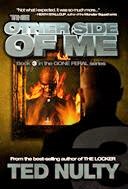
Other side of me cover (2)
Zombie Tour

Zombies, I’ve loved them since I saw ‘Night of the Living dead’. The overwhelming sense of dread at facing a swarm of the living dead is a rush. But they really became cool when they got fast, Dawn of the dead, 28 days later fast. Now single zombies were a threat where before it took a whole town to be scary.
I wrote ‘Gone Feral’ as a homage to all the zombie writers before me, but I wanted it to be real, I wanted it to make sense where sometimes some of the other tales left a little too much gap in the realm of plausibility. Watching CNN in a bar one night with some Marines, we saw a naked man going cannibal on another man on a freeway overpass in Florida. The story about bath salts was my inspiration for the series. You see every single aspect of the chemical poisoning of the population was ‘Gamed out’ at the Marine Corps EOC (Emergency Operations Center) at Camp Pendleton. I learned how many airplanes it would take to disperse a water soluble drug to 60% of the population. Throw in a little artistic license, and I was ready to go.
I did want to stay as close to the zombie “rules” as I could. So I made the chemical transferable through a bite. I also made the affected, immune to pain and hard to kill. Add in some rage and you are looking at as close to a zombie as I can realistically get.
The positive response from readers was quite a shock, and I immediately began work on book II at the behest of my small but growing fan base. I wrote ‘Barry’s Walk’ in response to that feedback and it turned out to be wildly popular with folks. Barry was a minor character in the first book that people said they wanted to know more about. I wrote it as a stand-alone novel and therefore had to include some of the story from the first book for continuities sake. I burned that sucker out in 30 days and had a blast doing it. I left a little cliff hanger there at the end just because I had another novel in mind. But I had another flight of fancy first and decided to scratch that itch.
‘The Other Side of Me’ is my homage to Jekyll and Hyde. I wanted to write about a really good person who through no fault of his own becomes a very evil monster, then I want that tortured character to face the challenge of reconciling his acts with the knowledge that it wasn’t his fault. Kind of a PTSD on steroids type of thing. Again the plot twist bug bit me, and I had to throw a few curve balls in there. The story is set in the ‘Gone Feral’ universe, and the drugs the terrorists use are the vehicle used to catapult this whole new cast of characters through a wild journey.
Did I mention I’m a Marine? Well I am, and we like challenges. So not only did I make my zombies hard to kill, and fast. I made sure that all mammals were affected by the drug, making Cats, Rats, Dogs, and Pigs (Especially pigs) susceptible to the effects of the toxin. This made the world exponentially more difficult to survive in. It also gave me more ways to herd, corral, push, or otherwise guide my characters into more trouble.
I can’t get through a day without some form of humor, so I have taken the task very seriously to introduce some form of off color shenanigans into my books. It’s what us Jarheads do to cope with stress, and I know it would happen in the real world. I have to confess that the kid humor is always taken from my devil spawn children. You’ll have to take it with a grain of salt (pun intended).
So thank you for joining us here on the Winter of Zombie Tour. I am humbled to be included with this very talented group of authors. I hope you enjoy our work, we enjoyed writing it for you.

Ted Nulty
Author pic
*   *   *   *   *
The stench of frozen flesh is in the air! Welcome to the Winter of Zombie Blog Tour 2015, with 40+ of the best zombie authors spreading the disease in the month of November.
Stop by the event page on Facebook so you don’t miss an interview, guest post or teaser…and pick up some great swag as well!
Giveaways galore from most of the authors as well as interaction with them!
#WinterofZombie is the hashtag for Twitter, too!
Guest Post - Rhonda Hopkins #WinterofZombie 2015

Guest Post: Rhonda Hopkins #WinterofZombie

Survival - Rhonda Hopkins
SURVIVAL: SKILLS AND KNOWLEDGE WE MAY NEED WHEN THE ZOMBIE SHTF

So I’ve been thinking. Yeah, I know. That can lead to dangerous situations. (Or funny, considering what a klutz I can be.) But hopefully not this time. This time, I’m actually trying to think of things I might need to know to keep me out of trouble in the event of an apocalypse. I know those zombies are just around the corner! And writing about the zombie apocalypse, I need to know at least these basics (or know where to get the info). I’m always coming up with something that I need to know when writing. Thank goodness for the internet and experts that are willing to offer up their knowledge.
Anyway, there are some skills that would definitely be valuable after TEOTWAWKI (The End of the World As We Know It). Now I know I can’t learn all of this. At least not quickly. But maybe having one or two skills to barter when cash is worth less than a pile of manure (after all, you can you manure for fertilizing) might be essential to survival.
So what kinds of things will we need? Here are a few of the things I think will be important skills and knowledge (things I’ve had to research while writing theSURVIVAL series or have on my list to research for my next book) in no particular order:
Farming — growing crops/gardening and raising livestock
Butchering (I hope someone else knows how to do this because it’s not on my want-to-know-skills list. But you do what you got to do, right?)
Hunting/Fishing/Trapping
Knitting/Crocheting
Curing/Tanning Animal Skins
How to Store and Preserve Foods – canning, drying, curing, pickling, etc.
Sewing
Making Soaps/Candles/Cleaning Supplies
Carpentry
Plumbing
Mechanical Knowledge
Knowledge of Solar Power
How to Operate a Ham Radio
Knowledge of Weapons – how to use, clean, and maintain
First Aid
Self-Defense
Now I know I’m not likely to learn how to set up a building to function on solar power, but there are a few things I can do, and most of you can do, to be more self-sufficient in a world turned upside down. For instance, we can all learn about self-defense, take a first aid class, learn to prepare and store food without a refrigerator or other appliances.
We can learn about a weapon or two. I already know how to handle my Glock, so adding one or two other weapons to that shouldn’t be a problem. I’ve fired other handguns when target shooting with friends. And I’m pretty good with a bow and arrow. I’d love to learn to use a crossbow effectively.
I’ve also gathered quite a collection of eBooks on canning and food prep as well as candle and soap making. So, I need to start putting those to use. And my aunt’s been trying to get me to let her teach me to crochet. I think it might be time. Hey! Those crochet hooks and knitting needles can become weapons if needed!
By the way – did you know you can make a candle out of a stick of butter in an emergency? While this might not help during an apocalypse, it might help if the electricity goes off and you don’t have any candles in the house.
Even if you never need any of these for a zombie apocalypse, just think how handy these survival skills could be in your everyday life. At least you’ll be a well-rounded person with a lot of different expertise for others to admire. So take a few classes, watch a few videos, read some books, and practice.
So that’s it. What did I miss? Let me know in the comments what skills or knowledge you think will be important after a zombie apocalypse.
Rhonda Hopkins
Award-winning author, Rhonda Hopkins, has learned firsthand that truth is stranger than fiction. Her two decades of experience as an investigator provide her characters with a depth and realism that gives truth a run for its money. Having come in contact with the best and the worst that society has to offer, Rhonda’s imagination is filled with story ideas. Rhonda writes horror, suspense, paranormal, and YA urban fantasy. She is the author of the zombie apocalypse series, SURVIVAL, and the award-winning paranormal novella, THE CONSUMING. She also has a non-fiction book, NAVIGATING FAMILY COURT: IN THE BEST INTEREST OF YOUR CHILD, to assist those going through custody litigation.
You can connect with Rhonda at:
Find more from Rhonda at Amazon:  http://www.amazon.com/Rhonda-Hopkins/e/B009KWDCCW
*   *   *   *   *
The stench of frozen flesh is in the air! Welcome to the Winter of Zombie Blog Tour 2015, with 40+ of the best zombie authors spreading the disease in the month of November.
Stop by the event page on Facebook so you don’t miss an interview, guest post or teaser…and pick up some great swag as well!
Giveaways galore from most of the authors as well as interaction with them!
#WinterofZombie is the hashtag for Twitter, too!

Guest Post - Jack Wallen #WinterofZombie 2015

Guest Post: Jack Wallen #WinterofZombie

jack_hands
Winter of Zombie 2015
Suspension of disbelief
One of the issues we horror writers often deal with is the readers willingness to suspend disbelief. What exactly is this magical turn of phrase? It was coined in 1817 by Samuel Taylor Coleridge who suggested if a writer could infuse a “human interest and a semblance of truth” into a fictional (and fantastical) tale, the reader would suspend judgment concerning the believability of the circumstances in the story.

This is something every reader of zombie horror fully understands. The problem, however, lies in just how much the reader is willing to suspend. Consider this:

You’re reading a novel about the apocalypse, one where humans have died and come back to life as brain/flesh eating machines of love and grace (or hate and indecency, depending on your bent). That is the big suspension. Why? As of this moment, the human creature, once dead, stays dead. There is no coming back from the big nap. You’ve willingly ignored that one essential component of the human condition, because without doing so would drive you mad otherwise – you’d spend every page, paragraph, sentence, and word cursing the writer for penning such improbable fiction.

Once we get beyond the big bad of suspensions, things start to get a bit dicey. How? Because as we climb down the ladder of intellect, rung by rung, we start dealing with topics that are much more “binary” than the idea of human re-animation. Add to that, we run across topics that certain cross sections understand quite well.

Take, for instance, the topic of weapons. There are some readers out there who know very little about guns. So when a writer says “Weapon X does Y”, that reader just buys into it. Other readers aren’t so ready to toss this aside. Weapon aficionados probably know that Weapon X doesn’t actually do Y, it does Z. So those readers are apt to toss up their arms and shout “I quit!”

Another hot topic in the realm of apocalyptic fiction is that of power. When the virus takes hold, there are varying schools of thought on how long the power grid will hold up. Some countries would go down quite quickly, whereas others might hold fast for a longer period. Certain types of power generation will last longer than others. Hydro-electric power will last quite a bit longer than coal. Solar will last indefinitely, so long as there is a sun. Where the idea of electricity gets very tricky in the world of fiction is when you attempt to apply the laws (and loss) of power, you wind up losing out on a great number of constructs that are often necessary to move along a plot. One good example in my I Zombie series is that ofZombie Radio. The DJ has managed, on a number of occasions, to save the day (or the sanity) of various and sundry groups. Without him not only would Bethany not be as capable, but the Zombie Radio series wouldn’t exist.

Another big suspension is that of biological engineering. I am not a bio-chemist (though I have played one on the stage), so the depth of my knowledge for creating cures for the Mengele virus (or any virus for that matter) is kiddy pool shallow. Thanks to the fact I didn’t get my Phd in bio-chem, readers have to be willing to suspend disbelief when it comes to matters of the molecule.

You see where this is going, right?

Post apocalyptic fiction is one of my favorite genres to write and read. Collected in the Winter of Zombie 2015 are some of the best writers in the genre – each of which delivers a particular spin on the story. Some of the writers rely heavily on military, some on militia. Some writers lean more on the global/social aspect of the apocalypse, while others depend upon the human story. Regardless of what each writer uses as their tools of the trade, there will be some suspension of disbelief necessary in order to get through the stories. That is part and parcel to the drama. We use our imaginations to get characters in and out of situations and drive the story (and series) arc forward. Sometimes, we have to bend the concepts of reality and physics to meet our needs. Hopefully you, the reader, are willing to bend as well.

I want to take a moment to thank each and every reader here; not only for your continued support, but for your willingness to suspend disbelief as you navigate the words of our post apocalyptic fiction. Without your wonderful and willing minds, none of us would be here right now.

Bend on ladies and gents, bend on.

Get more Jack
*   *   *   *   *
The stench of frozen flesh is in the air! Welcome to the Winter of Zombie Blog Tour 2015, with 40+ of the best zombie authors spreading the disease in the month of November.
Stop by the event page on Facebook so you don’t miss an interview, guest post or teaser…and pick up some great swag as well!
Giveaways galore from most of the authors as well as interaction with them!
#WinterofZombie is the hashtag for Twitter, too!